Medically reviewed by: Kristin Baier, MD
Both Wegovy® and Mounjaro® have recently been all over the news thanks to trending videos shared by celebrities and wellness influencers on social media. They’ve gained notoriety as “miracle” weight loss drugs—which, importantly, they are not.
However, they are both drugs prescribed by Calibrate clinicians as a part of Calibrate’s health-promoting Metabolic Reset and have been shown (in clinical trials) to improve blood sugar control in adults with overweight or obesity. When taken in conjunction with lifestyle changes, they can also promote weight loss.
How do Wegovy® and Mounjaro® work? Are they safe? And how do they differ from one another? We’re answering those questions and more below.
What is Wegovy® (semaglutide)?
Wegovy® (semaglutide) is a glucagon-like peptide-1 (GLP-1) receptor agonist (RA) that stimulates release of naturally-occurring hormone GLP-1, which regulates appetite, food intake, and glucose metabolism. By activating GLP-1 receptors in the brain, Wegovy® can reduce hunger and increase satiety, leading to a decrease in food intake.
Semaglutide is available under multiple brand names: There’s Wegovy®, as well as Ozempic® and Rybelsus®. All three are manufactured by Danish pharmaceutical company Novo Nordisk. Ozempic® and Rybelsus® are indicated for type 2 diabetes, whereas Wegovy® is specifically indicated for the treatment of overweight and obesity.
Wegovy® is the newest among the three semaglutide drugs, approved by the FDA in June 2021 for the treatment of obesity in adults with a body mass index (BMI) of 30 or higher or with a BMI of 27 or higher and at least one weight-related health condition.
What is Mounjaro® (tirzepatide)?
Mounjaro® (tirzepatide) is a dual glucose-dependent insulinotropic polypeptide (GIP) and GLP-1 receptor agonist that was approved by the FDA in May 2022 for the treatment of type-2 diabetes.
Mounjaro® may also be prescribed for weight loss, as clinical studies show it can be effective in treating overweight or obesity. Just as it does in adults with type-2 diabetes, Mounjaro® can improve blood sugar levels in adults with insulin resistance or prediabetes—and is an effective tool for weight loss among both groups.
Mounjaro® works similarly to the other drugs in the GLP-1 family, but the medication has a dual-action design, mimicking the action of not one but two incretin hormones involved in blood sugar control: Glucagon-like peptide-1 (GLP-1) and glucose-dependent insulinotropic polypeptide (GIP). This unique dual action makes it the first-in-class medicine that acts on both of these receptors.
According to a press release published by Eli Lilly, “GIP is a hormone that may complement the effects of GLP-1 receptor agonists. In preclinical models, GIP has been shown to decrease food intake and increase energy expenditure therefore resulting in weight reductions, and when combined with GLP-1 receptor agonist, may result in greater effects on markers of metabolic dysregulation such as body weight, glucose and lipids.”
How do drugs like Wegovy® and Mounjaro® work?
Both Wegovy® and Mounjaro® work by mimicking incretin hormones in the body—a type of hormone that is released whenever food is consumed. Among other things, they help promote a feeling of fullness by delaying gastric emptying and activating the satiety centers of the brain. They also boost insulin production in the pancreas, and suppress glucagon production, both of which help normalize blood sugar.
All of this happens in a glucose-dependent manner, which means incretin hormones—or their imitators, i.e. GLP-1 and GIP receptor agonists—are unlikely to cause severe hypoglycemia (unless combined with certain diabetic medications).
What about your natural incretin hormones? Studies have found that people with overweight or obesity may have a reduction in incretin effects, particularly if they have had frequent weight fluctuations due to yo-yo dieting. GLP-1-type medication narrows the gap, making it easier to reach your goals.
Wegovy®, Mounjaro®, and other medications in the GLP-1 family are impactful enough that they can help lower your set point: the weight your body naturally settles at due to an interplay of genetics, biology, and environment. In other words, they increase the likelihood that your weight loss will be sustainable.
Comparing Wegovy® (semaglutide) and Mounjaro® (tirzepatide)
Both Wegovy® and Mounjaro® have been proven effective not only in improving metabolic health, reducing hemaglobin A1C (hbA1C), and assisting with weight loss—the data also shows that they may reduce the likelihood of cardiovascular events such as heart attack or stroke and improve cardiovascular outcomes across the board.
While Mounjaro® acts on both GIP and GLP-1 receptors, Wegovy® acts solely on GLP-1 receptors. This doesn’t mean that Wegovy® is an inferior medication when it comes to improving metabolic health: How well Wegovy® (or any other drug) works for your body depends on a multitude of individual factors, ranging from your genetic profile and health history to your physical predispositions, lifestyle, and preferences.
You might find, for example, that semaglutide is easier for your body to tolerate and produces fewer side effects than another formulation of a GLP-1 drug, while still helping you reach your goals at the same pace. The same goes for dosage. Some individuals find that they need to titrate up to the maximum dose of a given GLP-1 drug fairly quickly, while others are able to make progress on a lower dose for an extended period.
Ultimately, your Calibrate clinician will help you determine the best medication for you based on all of the individual factors listed above, while also considering your insurance coverage and drug availability.
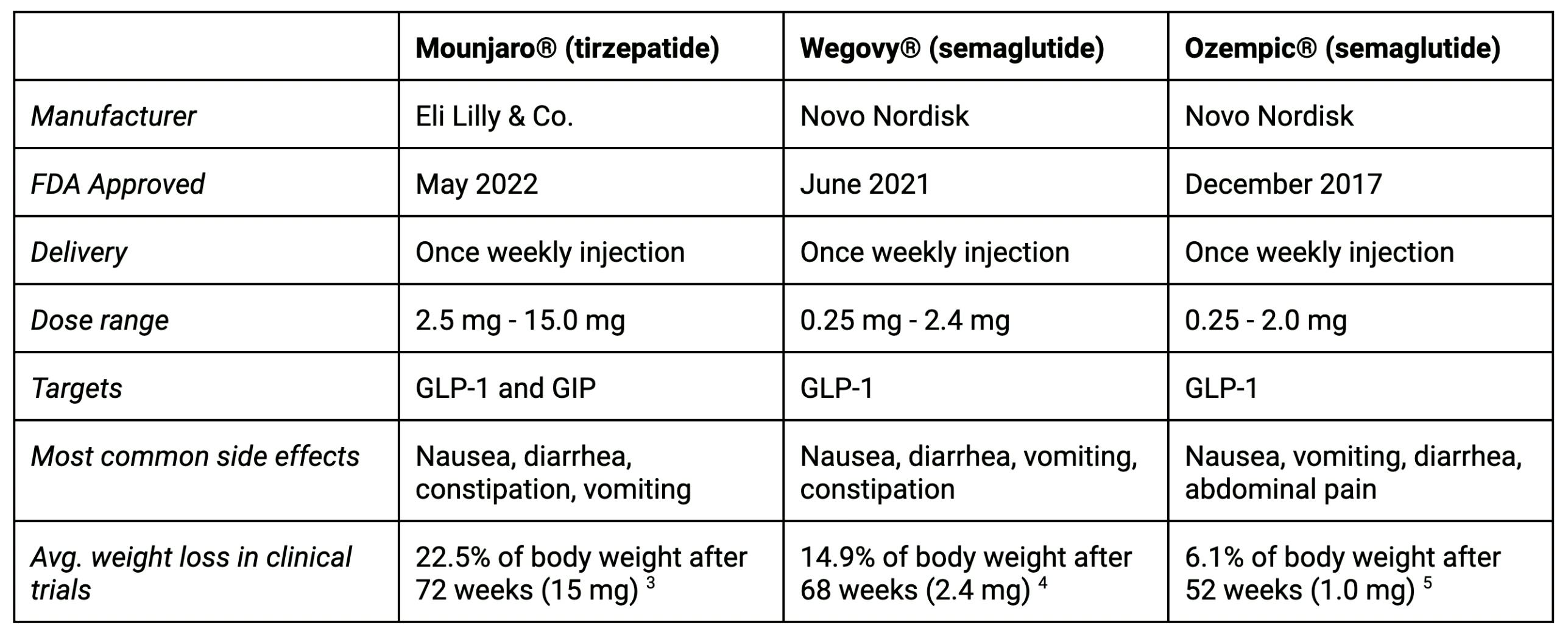
The below chart outlines some of the key similarities and differences between once-weekly tirzepatide (Mounjaro®) and injectable semaglutide (Wegovy® and Ozempic®). Of the three brands, Ozempic® has been on the market the longest.
Why Wegovy® (semaglutide) and Mounjaro® (tirzepatide) aren’t “magic jabs” for weight loss
Like other drugs in the GLP-1 family, Wegovy® and Mounjaro® are medications that make it easier to lose weight and stick to healthy habits—but they don't produce weight loss on their own.
All GLP-1 and dual GIP/GLP-1 drugs must be used in combination with other tactics to support metabolic health so you can sustain your body weight reductions. These tactics may include modifications to what you eat, how and when you exercise, and other healthy lifestyle changes.
Calibrate’s Metabolic Reset combines GLP-1 medication with evidence-based lifestyle recommendations—the Four Pillars of Metabolic Health—to help participants maximize their success with GLP-1 medications. These pillars include:
- FOOD: Calibrate’s food philosophy will help you find ways to eat more mindfully, while also help establish a sustainable and flexible approach to nutrition that focuses on minimizing fast-digesting carbs and making healthier choices that include fiber, protein, and healthy fats—without restricting or counting calories. These small and sustainable changes to your meal plan won’t just work to lower your blood sugar and improve your gut and overall health, you’ll also feel more in control of what you eat.
- SLEEP: Getting quality sleep is crucial to our brain and metabolic health. But consistency is also key: A 2018 study found a strong correlation between irregular sleep times and an increased risk of cardiometabolic health factors. At Calibrate, you will learn how to develop a schedule to improve sleep quality and minimize cardiometabolic health factors with 7-9 nightly hours of restful sleep.
- EXERCISE: It’s no secret that regular exercise can have a ripple effect of benefits on your overall health. Multiple studies show that exercise can improve your heart health, bone health, reduce your risk of cancer and risk of type 2 diabetes, and boost your mood. Calibrate’s exercise approach focuses on prioritizing movement plus two sessions of strength training each week, making it a regular and positive part of the day.
- EMOTIONAL HEALTH: We all know what it feels like to be stressed—whether your muscles tense up, your throat tightens, or your heart starts to beat faster, chronic stress can have a lasting impact on your mental and physical health. Unsurprisingly, stress levels can also influence hormones that affect your eating habits, metabolism, and weight. With Calibrate’s approach to emotional health, you’ll learn how to incorporate science-backed methods to reduce stress and recognize emotional triggers that influence metabolic health.
Calibrate’s approach to medical weight loss is rooted in biology and puts metabolic health at the center of every effort—not just the number on the scale. Our program is designed to help you make small tweaks to your food, sleep, exercise, and emotional health habits that are easy to sustain and personalized to your unique circumstances.
Calibrate members lose, on average, 15% of their body weight after completing their Metabolic Reset. Learn more.
Wegovy® vs. Mounjaro® availability: Is Mounjaro® available to Calibrate members?
Mounjaro® (tirzepatide) is one of the drugs currently prescribed by Calibrate clinicians for those enrolled in a Metabolic Reset and for whom it is clinically indicated.
When you join Calibrate, you’ll complete a Comprehensive Health Intake, including blood work, that your Calibrate clinician will carefully review before customizing your treatment plan and prescribing your medication. You may be eligible for tirzepatide or semaglutide even if you are already taking another type 2 diabetes medication such as metformin.
If your Calibrate medical team determines that Wegovy® or Mounjaro® is the right fit for you, they’ll walk you through all of the details on dosage, how to administer the medication, when to take it, and how it will work alongside your metabolic reset plan.
Ready to get started with Calibrate? Find out if you’re eligible today.

We’re a modern, medical approach that combines clinician-prescribed medication with 1:1 accountability coaching—all personalized to your biology, your goals, and your life for a metabolic reset that lasts and 10% Weight Loss Guaranteed (see terms).
See All from Calibrate
Related Articles
See AllSupporting Frontline Workers: Why Weight Loss Solutions Must Be Customizable
by CalibrateMarch 18, 2026